Ronda, Escoba and Scopa: three capturing games compared
By The Atlas Carta teamUpdated on
Play Ronda online
One family: capturing games
Card game specialists class all three as “fishing games”: cards lie face up in the middle, each player plays a card from hand and “fishes” whatever it can take. All three use 40 cards (no 8s or 9s), with two players or four in teams, and give the cards left in the middle at the end of the round to the side that captured last. The Escoba and Scopa rules described here are the most widespread; as with Ronda, every table has its habits.
The table of differences
| Ronda | Escoba | Scopa | |
|---|---|---|---|
| Deck | 40 Spanish cards | 40 Spanish cards | 40 Italian cards (or Spanish) |
| Face card values | Sota 10, Cabal 11, Rey 12 | Sota 8, Caballo 9, Rey 10 | Fante 8, Cavallo 9, Re 10 |
| Start | Empty table (app rule) | 4 cards face up in the middle | 4 cards face up in the middle |
| Capture | Same value + the run going up | Cards adding up to 15 with the card played | Same value, or cards adding up to the card played |
| Table cleared | Missa: +1 | Escoba: +1 | Scopa: +1 |
| Answering the opponent | B'wahed 1, B'khemsa 5, B'3echra 10 | — | — |
| Hand declarations | Ronda 1, Double Ronda 2, Tringa 5 | — | — |
| End of round | +1 per card above 20 | Most cards, most coins, 7 of coins, most 7s | Most cards, most coins, 7 of coins, primiera |
| Usual target | 33 points | 15 or 21 points depending on the table | 11 points (sometimes 21) |
Capturing: run, sum or equal value
This is the difference that changes everything. In Ronda you never add up: you look for the same value, and you also take the unbroken run above it, in the order 1 to 7 then 10, 11, 12.
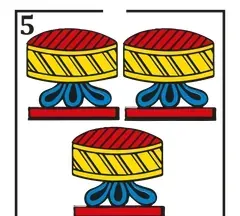 5 of cups
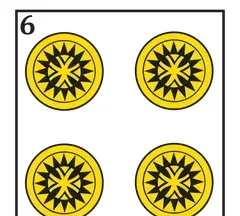 6 of coins
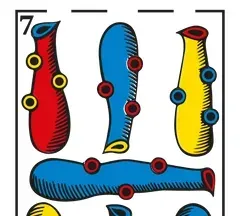 7 of clubs
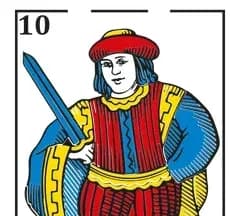 Sota of swords
In Escoba you add: the card played must make 15 with one or more cards in the middle. Face cards count 8, 9 and 10 there, so the same card is not worth what it is in Ronda.
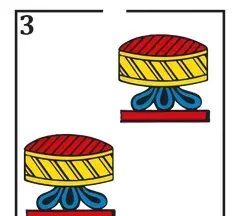 3 of cups
- 7 of clubs
In Scopa, the card played takes a card of the same value or several cards whose sum equals it; when a card of the same value is on the table, that is the one you must take.
- 3 of cups
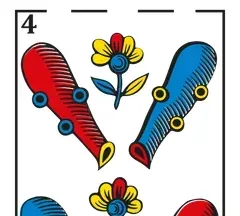 4 of clubs
Clearing the table: Missa, escoba and scopa
All three games award 1 point to the player who leaves the middle empty when capturing: the Missa in Ronda, the escoba (the “broom”) in Escoba, the scopa in Scopa. In the app's Ronda, the Missa is added to a chain gain (up to 11 points with a B'3echra), and it does not count with the very last card of the round played by the dealer. In Scopa, the last capture of the round does not count as a scopa either.
Because Ronda starts on an empty table, the first cards laid are often alone: Missas are frequent, and protecting the table is part of Ronda strategy.
What only Ronda has
- Chains of plays: laying the same value as the card the previous player just left on the table scores 1 point (B'wahed), then 5 (B'khemsa) and 10 (B'3echra) if the chain goes on. Only the last player in the chain scores.
- Declarations: after each deal, a pair (Ronda, 1 point), two pairs (Double Ronda, 2) or three of a kind (Tringa, 5). The best declaration takes the value of all the others.
- The run: a capture takes every consecutive value present on the table, which makes low cards precious.
- Scoring as you go: every gain counts at once, and the game stops as soon as a side reaches 33, even mid-round.
Every Ronda term is explained in the Ronda glossary.
Play Ronda online
The end-of-round count
In Escoba and Scopa, most points are won after the round, by comparing piles: the most cards, the majority of one suit (coins), the 7 of that suit and, depending on the game, the majority of 7s or the “primiera”, a combination worked out from the best card of each suit. A game is therefore played to few points: 11, 15 or 21.
In Ronda, suits never count. The only end-of-round bonus is the number of cards: 20 cards are worth 0, and each card above that scores 1 point. Most points come from play itself (chains, Missas, declarations), hence a higher target of 33. Full scoring: Ronda scoring.
Which one suits you?
- You like to calculate and combine several cards at once: Escoba and Scopa are made for you.
- You like memory, reflexes and a direct duel with the player next to you: Ronda, with its chain answers and declarations, plays faster and sharper.
- You already play one of the three: the other two can be learned in a single game, as long as you keep the way of capturing in mind.
In the Atlas Carta app, Ronda is the one you will find, alongside Touti, Rummy and Belote. For a wider look at related games (Caída, Cuarenta, Casino) and Ronda variants, see Ronda variants and history.
Frequently asked questions
What is the difference between Ronda and Escoba?
In Ronda you capture the card of the same value and the run above it, with chains of plays and declarations; you win at 33. In Escoba you capture cards that add up to 15 with the card played, and most points are counted at the end of the round.
Are Scopa and Ronda played with the same deck?
Both use 40 cards. Scopa traditionally uses the Italian deck and Ronda the Spanish deck; face cards have different values (8, 9, 10 in Scopa, 10, 11, 12 in Ronda).
Is Ronda's Missa the same as a scopa?
The idea is the same: clearing the table when capturing scores 1 point. In Ronda, the Missa can also be added to the gain of a chain.
Can you play Escoba or Scopa in Atlas Carta?
No. Atlas Carta offers Ronda, Touti, Rummy and Belote.
Read also
Other games on Atlas
- ToutiTrick-taking and bidding card game (bids from 70 to 230) for 4 players in 2 teams, played with a 40-card Spanish deck; the first team to 600 points wins.
- RummyRummy game with two 52-card decks and jokers: you lay down runs (Suivi, e.g. 7♥ 8♥ 9♥) and sets (Tria, e.g. 9♠ 9♥ 9♦). Simple, Rummy 51 and Rummy 71 modes, 1 vs 1 or 2 vs 2.
- BeloteTrick-taking game with trumps and declarations, for 4 players in 2 teams of 2. Moroccan variant with 32 Spanish cards to 1,000 points, or French variant with 32 French-suited cards to 1,000 points.
Play Ronda online
On iOS and Android, play all four games online and invite your friends to a private table.