
Ronda strategy: how to win
By The Atlas Carta teamUpdated on
Play Ronda online
The basics: four copies of every value
It all starts from one simple fact: the deck holds exactly 4 cards of each value. Every time a value is played, you know how many copies are left in your opponents’ hands or in the deck. That count drives almost everything: the risk of a B'wahed, the chance of a Missa, how much your declarations are worth.
- Tip 1 — Count by value, not by suit. Suits are irrelevant in Ronda. Just remember: “three 6s are out, one is left.”
- Tip 2 — Look at your hand before the table. A value you hold twice is a weapon: if your opponent plays one, you answer with a B'wahed.
Never hand over a B'wahed
When you lay down a card without capturing, the next player can answer it with the same value and score. Before you play, ask yourself: how many copies of this value are still hidden?

- Tip 3 — Prefer a “dead” value. If the other three 4s are already out, nobody can answer your 4.
- Tip 4 — Beware the value you hold twice. Playing one of your two 7s leaves two 7s unaccounted for: the next player may hold one.
- Tip 5 — The last card of a deal is safe. A new deal breaks any chain, so the last card played in a deal (the dealer’s) can never be answered with a B'wahed.
Starting and extending a chain
A chain only pays its last player. A 1-point B'wahed can be taken over as a B'khemsa (5) by the next player, then as a B'3echra (10).
- Tip 6 — Before a B'wahed, count the remaining copies. If the other two are already out, your B'wahed is safe. If one is still hidden, the next opponent may take 5 points off you.
- Tip 7 — Hold on to the third copy. After an opposing B'wahed, the next player is always on your team (the partner of whoever laid the card). If that is you and you hold the third copy, answer: their point becomes 5 points for your team.
Managing the Missa
Whenever the table can be cleared in one go, someone may score a Missa.
- Tip 8 — Do not leave a single card on the table, especially if its value is not “dead”: anyone holding the same value takes it and scores the Missa.
- Tip 9 — Beware of complete runs. A fully linked 5-6-7 table is cleared by a single 5. Breaking the run (leaving a gap) protects the table.
Play low to take long runs
Captures always go upwards: a 5 takes 5, 6, 7, 10… up to the first gap. Low cards are therefore the ones that collect the most — and each card above 20 is worth 1 point at the end of the round.
- Tip 10 — Keep a low card for the moment the table holds a long run.
- Tip 11 — Remember the 7 → 10 jump. A 7 that captures also takes the Sota, Cabal and Rey if they are on the table.
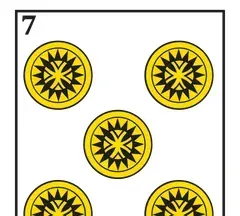 7 of coins
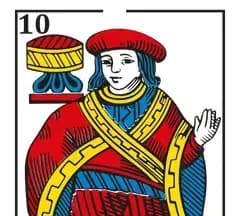 Sota of cups
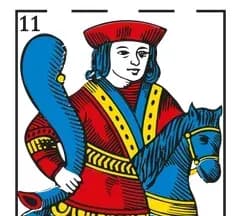 Cabal of clubs
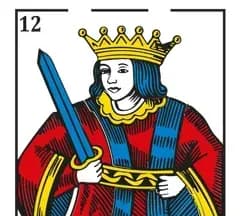 Rey of swords
Declare or keep quiet?
Declaring is optional, and the best declaration takes the value of all the others. Declaring a low Ronda against a higher one simply hands your opponents an extra point.
- Tip 12 — Almost always declare a Tringa. It beats every Ronda, single or double: if nobody has better, you take its 5 points plus every opposing declaration. Only a higher opposing Tringa can beat it, and that Tringa then takes yours too: it is rare, but it is not a guaranteed win.
- Tip 13 — Declare a high Ronda without hesitation (Rey, Cabal, Sota). A Ronda of Aces or 2s is a risk: it only wins if nobody declares a higher pair.
| Hand dealt | Ronda (one pair) | Two pairs | Tringa | No declaration |
|---|---|---|---|---|
| 4 cards | 37.8% | 1.8% | 1.6% | 58.8% |
| 3 cards | 21.9% | — | 0.4% | 77.7% |
With 4 cards you have roughly a 4 in 10 chance of holding at least one pair. With four players, several people often declare in the same deal, so the height of your pair really matters. (Four of a kind, extremely rare, counts as a Double Ronda and is included under “two pairs”.)
Playing 2 vs 2
The two teams alternate around the table: the card you lay down is always answered first by an opponent, and your partner plays right after them.
- Tip 14 — Play for the team. Whatever you leave on the table benefits the opponent after you first, not your partner. Before playing, check what that opponent could capture or answer: a lone card, a complete run, or a value they could hit with a B'wahed. As for declarations, your two hands never compete: the better one represents the team.
What changes in 1 vs 1
With two players, the round is played in five deals of 4 cards. Every card you cannot see in your hand or on the table is either in your opponent’s hand or in the deck, so card counting pays off even more. And every card you lay down without capturing is a direct invitation to your opponent’s B'wahed.
End of the deal, end of the game
- Tip 15 — Watch the score near 33. The game ends the moment one side reaches 33, even mid-round. If your opponents are on 31 or 32, a single B'wahed or Missa is enough for them: play safe. If it is you, go for the missing point.
Also think about the cards left on the table at the end: they go to the side that captured last. A late capture can bring in several cards, and therefore bonus points. Remember: the dealer scores no Missa with the very last card of the round.
10 beginner mistakes
- Thinking suits matter: only the value counts.
- Forgetting that runs jump from 7 to 10.
- Thinking runs go down: they always go up from the captured card.
- Trying a B'wahed on a card played two turns ago: you must answer immediately.
- Thinking a B'wahed followed by a B'khemsa is worth 6: only the last player scores.
- Declaring a low Ronda against a stronger opposing declaration and handing them a point.
- Assuming a Double Ronda always beats a Ronda: the highest pair decides.
- Leaving a single card on the table and gifting a Missa.
- Forgetting that a new deal breaks the chain.
- Playing out the round without watching the score: the game can end at 33 at any moment.
Play Ronda online
Frequently asked questions
What is the best strategy in Ronda?
Counting cards by value. Knowing how many copies of each value are still hidden lets you avoid giving away B'waheds, make your own safely and judge your declarations.
Should you always declare your Ronda?
No. A high Ronda or a Tringa, yes. A low Ronda is a risk: if an opponent declares a higher pair, your declaration gives them a point.
What are the odds of getting a Ronda?
With a 4-card hand, about __RONDA_PROBABILITY_33__ to hold at least one pair (Ronda, two pairs or Tringa); with 3 cards, about 22%.
How do you avoid giving away a B'wahed?
When you cannot capture, play a value whose other copies are already out — or, if you are the dealer, keep your risky card for the very end of the deal: a new deal breaks the chain.
Read also
Other games on Atlas
- ToutiTrick-taking and bidding card game (bids from 70 to 230) for 4 players in 2 teams, played with a 40-card Spanish deck; the first team to 600 points wins.
- RummyRummy game with two 52-card decks and jokers: you lay down runs (Suivi, e.g. 7♥ 8♥ 9♥) and sets (Tria, e.g. 9♠ 9♥ 9♦). Simple, Rummy 51 and Rummy 71 modes, 1 vs 1 or 2 vs 2.
- BeloteTrick-taking game with trumps and declarations, for 4 players in 2 teams of 2. Moroccan variant with 32 Spanish cards to 1,000 points, or French variant with 32 French-suited cards to 1,000 points.
Play Ronda online
On iOS and Android, play all four games online and invite your friends to a private table.