Ronda rules: how to play, step by step
By The Atlas Carta teamUpdated on ✓ Rules checked in the app
Play Ronda online
Equipment and players
You need a 40-card Spanish deck and two or four players. Nothing else: the middle of the table — the table or “carpet” — is the shared playing area.
The 40-card Spanish deck
Four suits — oros (coins), copas (cups), espadas (swords) and bastos (clubs) — of ten cards each: 1 (Ace), 2, 3, 4, 5, 6, 7 and the face cards Sota (10), Cabal or Caballo (11) and Rey (12). There are no 8s or 9s. In Ronda only the value matters: suits play no part at all.
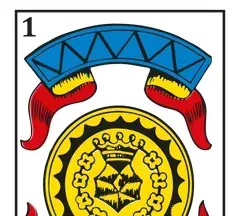 Ace of coins
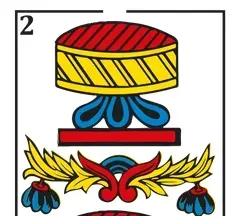 2 of cups
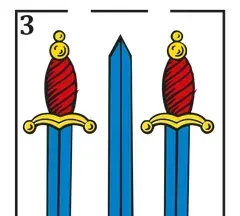 3 of swords
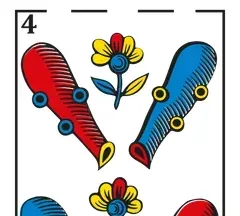 4 of clubs
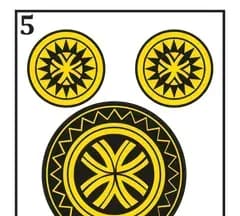 5 of coins
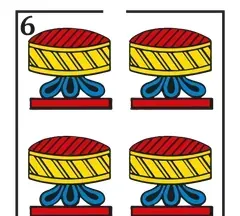 6 of cups
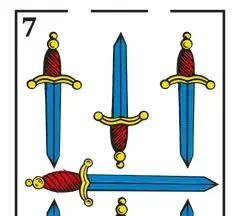 7 of swords
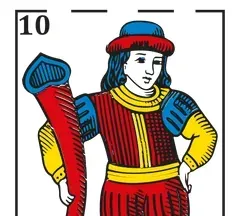 Sota of clubs
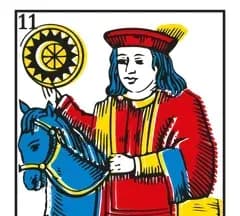 Cabal of coins
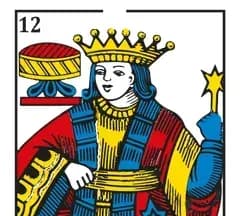 Rey of cups
More on the face cards and run order: the Ronda cards.
2 players (1 vs 1) or 4 players (2 vs 2)
With four, you form two teams of two; partners sit opposite each other, so the two teams alternate around the table. With two, it is a straight duel. In this guide, “side” means the team in a four-player game and the player in a two-player game.
Object of the game: reach 33 points
The first side to reach 33 points wins. Points come from four sources: chain plays (B'wahed, B'khemsa, B'3echra), the Missa, declarations (Ronda, Double Ronda, Tringa) and, at the end of each round, cards captured above 20. A game usually lasts several rounds.
Dealer, direction of play and dealing
The first dealer is chosen at random; after that the deal passes to the right with each new round. Play goes counter-clockwise: the player to the dealer’s right is dealt first and plays first; the dealer always plays last.
With 4: three deals of 4, 3 and 3 cards
Each player first receives 4 cards. When every hand is empty, the dealer gives everyone 3 cards, then 3 more: 4 + 3 + 3 = 10 cards per player, 40 in all. The third deal is the last of the round: at many tables the dealer marks it with “Khlassou”, a traditional word meaning “that’s it, all done”.
With 2: five deals of 4 cards
In 1 vs 1, each player receives 4 cards per deal, five times in a row, until the deck runs out (5 × 4 × 2 = 40). The fifth deal is the last one, the deal that the traditional word “Khlassou” greets around the table.
No cards on the table at the start
The round starts with an empty table. Cards played without capturing stay there, including from one deal to the next: the table is never cleared between deals.
Playing a card and capturing
On your turn you play exactly one card face up onto the table. What happens next depends on what is in the middle.
Capturing a card of the same value
If a card of the same value as yours is on the table, you take it together with your card. Suits do not matter: a 5 of coins takes a 5 of clubs. Captured cards go face down in front of your side and count at the end of the round.
The run: taking the cards that follow too
You do not only take the matching card: you also take the whole unbroken run that continues upwards from it. The order is 1, 2, 3, 4, 5, 6, 7, 10, 11, 12 — the 7 is followed directly by the Sota (10). The run stops at the first gap.
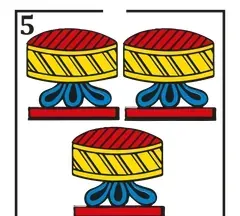 5 of cups
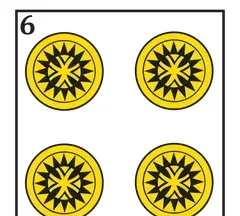 6 of coins
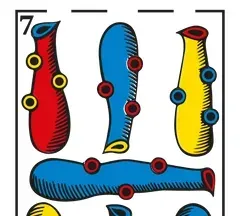 7 of clubs
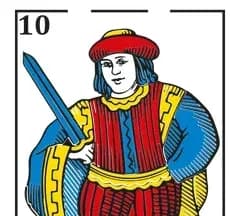 Sota of swords
- Rey of cups
- 5 of coins
No capture: the card stays on the table
If there is no card of your value on the table, your card stays there for everyone to see. That is where things get interesting: the next player may answer it with the same value…
Chain plays: B'wahed, B'khemsa, B'3echra
When a player lays down a card without capturing anything, the next player — an opponent — may answer it immediately with a card of the same value. That starts a chain of plays worth more and more.
| Play | Situation | Points |
|---|---|---|
| B'wahed | 2nd matching card, played right after the 1st | 1 |
| B'khemsa | 3rd matching card, played right after | 5 |
| B'3echra | 4th matching card, played right after | 10 |
B'wahed (1 point)
Your opponent has just played a 7 that captured nothing. You immediately play another 7: that is a B'wahed. Both 7s, plus any run on the table above the 7 (10, 11…), gather into a pile that stays in the middle for now.
- 7 of clubs
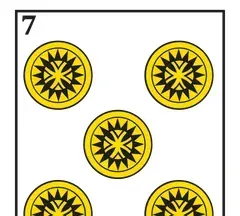 7 of coins
B'khemsa (5 points)
If the next player — your opponent — then plays the third 7, that is a B'khemsa, worth 5 points. Their card joins the pile, which still stays in the middle. With four players, it is the first player’s partner who answers, taking the play away from your team.
B'3echra (10 points)
If the next player plays the fourth 7, that is a B'3echra: 10 points, the strongest play in the game. There are only four cards of each value, so the chain ends there and that player picks up the whole pile at once.
Who collects, and how much? One gain, for the last player
The chain ends as soon as the next player plays a different value. Then only the last player in the chain scores, and they collect the whole pile (the matching cards and their run). Gains do not add up: you score 1 or 5 or 10, never 1 + 5 + 10.
- Chain stopped after the B'wahed: the B'wahed player scores 1 and collects.
- Chain stopped after the B'khemsa: its player scores 5 and collects; the opposing B'wahed earns nothing.
- B'3echra: 10 points and an immediate pick-up.
The Missa: clearing the table
If your capture leaves the table completely empty, you score a Missa: +1 point. When the pick-up comes from a chain, it is added to the chain gain:
| Capture | Total |
|---|---|
| Plain capture that clears the table | 1 |
| B'wahed + Missa | 2 |
| B'khemsa + Missa | 6 |
| B'3echra + Missa | 11 |

Declarations: Ronda, Double Ronda, Tringa
As soon as you receive your cards, check whether you hold cards of the same value: you can declare them for points. That is where the game gets its name.
When to declare
After every deal, all players declare at the same time. Declaring is optional: you may pass. During the deal, the others only see the type of your declaration (Ronda, Double Ronda or Tringa), not the value of your cards.
What each declaration is worth
| Declaration | Hand | Points |
|---|---|---|
| Ronda | Two cards of the same value | 1 |
| Double Ronda | Two pairs (4-card hand) | 2 |
| Tringa | Three cards of the same value | 5 |
- 6 of cups
- 6 of coins
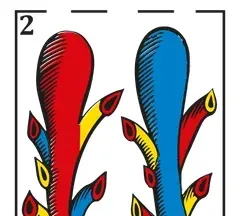 2 of clubs
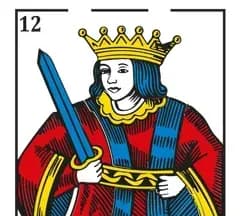 Rey of swords
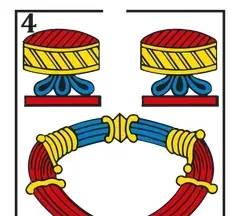 4 of cups
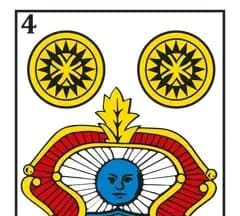 4 of coins
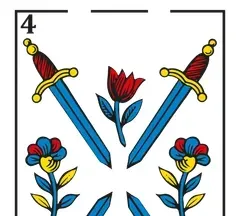 4 of swords
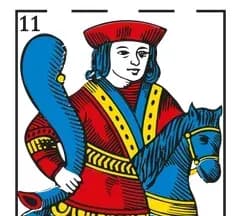 Cabal of clubs
A Double Ronda (two pairs) can only be declared on the first deal of the round; on later deals, two pairs count as a single Ronda (the higher one). Four cards of the same value count as two Rondas, i.e. a Double Ronda, and that holds on any deal: with four players only the first deal (4 cards) makes it possible, but in 1 vs 1, where every deal is 4 cards, four of a kind is a Double Ronda on the second deal just as on the fifth.
Who wins the declarations
Declarations are not scored separately: the best declaration takes the value of all the declarations made in that deal. To find the best one:
- A Tringa always beats any Ronda, single or double. Between two Tringas, the higher value wins.
- Between Rondas (single or double), the highest pair wins: a Double Ronda does not automatically beat a Ronda. Face value counts: the Rey (12) is highest, the Ace (1) lowest.
- Exact tie between the two sides’ best declarations: the points of all declarations are split equally, any half point rounded down.
Example: you declare a Ronda of 6s (1 point) and an opponent a Ronda of Reyes (1 point). Their pair is higher, so their side scores 2 points — your declaration helped them. Another: a Double Ronda (6s and 3s) against a Ronda of 7s: the 7 beats the 6, so the Ronda of 7s wins 2 + 1 = 3 points.
When the type alone settles the winner (only one team has a Tringa, for instance), the points are scored right away without revealing the cards. Otherwise the values are revealed and the points scored at the end of the deal, before the next one.
In teams: partners never compete
If both partners declare, they do not compete: the better of the two represents the team, and if it wins, the team takes the value of all declarations in that deal.
End of the round and counting cards
The round ends when all 40 cards have been played. Any cards left on the table go to the side that captured last (if nobody captured anything all round, to the dealer’s side). Each side then counts its cards:
- 20 cards = 0 points (half the deck);
- +1 point for each card above 20: 23 cards = 3 points, 27 cards = 7 points;
- fewer than 20 cards: 0 points (you lose nothing).
Points from chain plays, Missas and declarations are already on the scoreboard: the end of the round only adds this card bonus. Worked examples: how to count Ronda points.
End of the game: 33 points, instantly
Every gain (chain play, Missa, declaration) is added to the score immediately. As soon as one side reaches 33 points, the game ends, even in the middle of a round. If both sides are tied on 33 or more, play continues until one pulls ahead. Otherwise a new round starts with the next dealer.
Example: an annotated deal
Four-player game. Order of play: You, then East (opponent), North (your partner) and West (opponent and dealer). Empty table. Declarations: you declare a Ronda (you hold two 6s), and so does West (two Reyes). Same type, so the values will be compared at the end of the deal.
- You: 2 of clubs. Nothing to capture; the card stays on the table.
- East: 2 of coins. Same value, right after you: B'wahed (1 point in play for East-West).
- North: 2 of cups. A third 2 in a row: B'khemsa! The play passes to your team (5 points in play).
- West: 4 of swords. The chain stops: North scores 5 points and collects the three 2s. The table is empty: Missa, +1. Your team: 6 points. West’s 4 sits alone on the table.
- You: Rey of clubs. Nothing to capture. Table: 4, 12.
- East: 5 of coins. Nothing to capture. Table: 4, 12, 5.
- North: 4 of cups. Takes the 4 and the run: the 5 (no 6 on the table, so the run stops). Table: 12.
- West: Rey of coins. Takes the Rey: empty table, Missa (+1 for East-West). It is not a B'wahed: your Rey was played two turns earlier, not just before.
The deal continues with the eight remaining cards (two each). At its end the declarations are revealed: West’s Ronda of Reyes beats your Ronda of 6s, and East-West score 2 points (both declarations). On the plays shown here alone, your team leads 6–3; that score does not include whatever the remaining cards may still bring.
App rules and common variants
Ronda is mostly passed on by word of mouth, and every table has its habits. The Atlas Carta app uses one single rule set — the one in this guide. These are the most common differences you will meet elsewhere:
| Rule | In the Atlas Carta app | Also seen elsewhere |
|---|---|---|
| Two-player start | 5 deals of 4 cards, empty table | 3 cards each and 4 cards face up on the table |
| Chain points | One gain only: 1, 5 or 10 | Cumulative gains (1 + 5 + 10) |
| Name of three of a kind | Tringa | Tringla, Rondín |
| Name of a cleared table | Missa | Mesa, mesa limpia |
| End of game | 33 points, instant win | Other targets, a rule called 9a3a |
The full picture and related games: Ronda variants and history.
Play Ronda online
Frequently asked questions
How do you play Ronda?
Players take turns playing one card. If a card of the same value is on the table, you take it with the whole run above it. Answering your opponent with the same value scores 1, 5 or 10 points, clearing the table 1 point, and declarations 1, 2 or 5 points. The first side to 33 wins.
How many cards does each player get in Ronda?
With four players: 4 cards, then 3, then 3 (10 per round). With two: 4 cards per deal, five times, so 20 per round.
How many points do you need to win Ronda?
33 points. The game ends as soon as one side gets there, even mid-round.
What is a Missa in Ronda?
Clearing the table completely with a capture: +1 point, added to any chain play (B'wahed + Missa = 2). There is no Missa on the dealer’s very last card.
What is the difference between a Ronda and a Tringa?
A Ronda is a pair (1 point); a Tringa is three cards of the same value (5 points). A Tringa always beats a Ronda.
Do the 7 and the 10 follow each other in Ronda?
Yes. The 40-card Spanish deck has no 8s or 9s, so a run goes from 7 to Sota (10), then Cabal (11) and Rey (12).
Do you have to declare your Ronda?
No, declaring is optional. Staying quiet keeps your hand secret, but you give up the points. Careful: if an opponent has a better declaration, your Ronda gives them an extra point.
Can you make a B'wahed with a run?
No. A B'wahed requires the same value as the card the previous player just laid down. Capturing their card through a run is a normal capture.
Who gets the cards left at the end of the round?
The side that captured last. If nobody captured anything all round, they go to the dealer’s side.
Can you play Ronda with 3 players?
Some tables do, but it is a variant. The Atlas Carta app rules cover 1 vs 1 and 2 vs 2.
Read also
Other games on Atlas
- ToutiTrick-taking and bidding card game (bids from 70 to 230) for 4 players in 2 teams, played with a 40-card Spanish deck; the first team to 600 points wins.
- RummyRummy game with two 52-card decks and jokers: you lay down runs (Suivi, e.g. 7♥ 8♥ 9♥) and sets (Tria, e.g. 9♠ 9♥ 9♦). Simple, Rummy 51 and Rummy 71 modes, 1 vs 1 or 2 vs 2.
- BeloteTrick-taking game with trumps and declarations, for 4 players in 2 teams of 2. Moroccan variant with 32 Spanish cards to 1,000 points, or French variant with 32 French-suited cards to 1,000 points.
Play Ronda online
On iOS and Android, play all four games online and invite your friends to a private table.