
Two-player Ronda: the 1 vs 1 duel
By The Atlas Carta teamUpdated on ✓ Rules checked in the app
Play Ronda online
What changes with two players
| Rule | 1 vs 1 | 2 vs 2 |
|---|---|---|
| Dealing | 5 deals of 4 cards | 3 deals: 4, 3 then 3 cards |
| Cards per player per round | 20 | 10 |
| Possible declarations | On every deal, 4-card hands | 4-card hands on the 1st deal, 3 cards after |
| Four cards of the same value | Double Ronda, on any deal | Double Ronda, 1st deal only |
| Chain of plays | Alternates between the two players | Alternates between the two teams |
| Target | 33 points | 33 points |
Everything else is the same: capturing with a run, the Missa, the Ronda scoring and the instant stop at 33.
Setting up and dealing
- The dealer is drawn at random for the first round, then the deal alternates between the two players every round.
- Five deals of 4 cards: 5 × 4 × 2 = 40, the whole deck passes through your two hands.
- The non-dealer plays first on every deal; the dealer always lays the last card of the deal.
- The table starts empty and is never cleared between deals: uncaptured cards wait for the next deal.
Capturing and chaining plays head to head
On your turn you lay one card: if its value is on the table, you take it along with the run above it, and that capture is compulsory. Otherwise your card stays on the table… and your opponent can answer it.
With two players, the chain is a game of ping-pong: if your opponent answers your card with the same value, that is a B'wahed (1 point); if you then lay the third, your B'khemsa (5) wipes out his B'wahed; if he lays the fourth, his B'3echra (10) wipes out the lot. Only the last player in the chain scores and takes the pile.
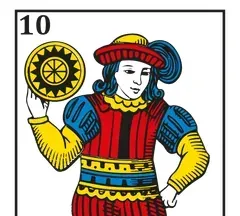 Sota of coins
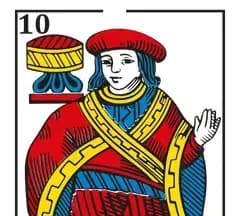 Sota of cups
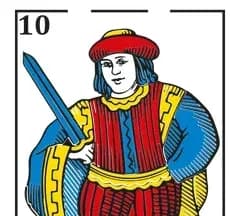 Sota of swords
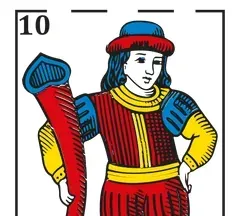 Sota of clubs
Declarations in 1 vs 1
After every deal, both players may declare a combination from their 4-card hand. As in teams, declaring is optional and the best declaration takes the value of every declaration of the deal.
| Hand | Declaration | Points |
|---|---|---|
| One pair | Ronda | 1 |
| Two pairs, 1st deal | Double Ronda | 2 |
| Two pairs, deals 2 to 5 | Ronda (the higher pair) | 1 |
| Four of a kind, any deal | Double Ronda | 2 |
| Three of a kind | Tringa | 5 |
- Sota of coins
- Sota of cups
- Sota of swords
- Sota of clubs
Example: on the third deal you declare a Ronda of 4s and your opponent a Double Ronda (his four Sotas). Same family of declaration: the higher pair wins, 10 against 4. Your opponent scores 3 points (2 + 1) at the end of the deal. Had your best pairs been equal, the total would have been shared, half points rounded down.
Worth knowing: a 4-card hand holds a declaration about 4 times in 10. Over the five deals of a round, each player therefore has a combination on about two deals on average.
End of round and the card count
- Cards left on the table go to the last player who captured; if nobody captured anything in the round, to the dealer.
- Each player counts their cards: 20 cards = 0 points, then +1 for each card above 20. The deck has 40: only one player can score this bonus.
- No Missa with the very last card of the round, played by the dealer.
- Every gain is added to the score at once: the game stops as soon as one player reaches 33, even mid-round.
6 tips to win head to head
- Count everything. Whatever you cannot see in your hand, on the table or in the piles is with your opponent or in the deck. On the fifth deal the deck is empty: the cards you have not seen are exactly your opponent's 4 cards.
- Play your position. When you are not dealing, your last card of the deal is followed by the dealer's, who can still answer it with a B'wahed: keep for that moment a value whose other copies are all gone.
- The pair trap. Laying one of your two matching cards invites an opposing B'wahed that you answer with a B'khemsa, provided you know the fourth copy is already out.
- Capture before you lay. Leaving a card your opponent can take with a B'wahed often costs more than a small capture.
- Dealer, keep your risky card for the end of the deal: the next deal will protect it.
- Think about the card bonus. Head to head, the player above 20 cards is sure to score; a long run captured late in the round can be worth several points.
Play Ronda online
Two-player Ronda at other tables
Many tables play the duel differently: each player gets 3 cards and 4 cards are turned face up in the middle at the start of the round. The Atlas Carta app keeps the rule described here, an empty table and five deals of 4 cards. Other customs are gathered in the Ronda variants.
Want to test yourself? The Ronda quiz covers the key situations, head to head and in teams.
Frequently asked questions
Can you play Ronda with two players?
Yes. With two, each player receives 4 cards per deal, over five deals, with an empty table at the start. You win at 33 points, as with four.
How many cards are dealt in two-player Ronda?
4 cards each, five times per round: 20 cards per player, the whole 40-card deck.
What are four of a kind worth in 1 vs 1?
A Double Ronda (2 points), on any deal. Two different pairs are only a Double Ronda on the first deal; after that they count as a Ronda.
Who starts in two-player Ronda?
The player who is not dealing plays the first card of every deal; the dealer lays the last one. The deal alternates between the two players every round.
Read also
Other games on Atlas
- ToutiTrick-taking and bidding card game (bids from 70 to 230) for 4 players in 2 teams, played with a 40-card Spanish deck; the first team to 600 points wins.
- RummyRummy game with two 52-card decks and jokers: you lay down runs (Suivi, e.g. 7♥ 8♥ 9♥) and sets (Tria, e.g. 9♠ 9♥ 9♦). Simple, Rummy 51 and Rummy 71 modes, 1 vs 1 or 2 vs 2.
- BeloteTrick-taking game with trumps and declarations, for 4 players in 2 teams of 2. Moroccan variant with 32 Spanish cards to 1,000 points, or French variant with 32 French-suited cards to 1,000 points.
Play Ronda online
On iOS and Android, play all four games online and invite your friends to a private table.