Touti strategy: how to win more often
By The Atlas Carta teamUpdated on ✓ Rules checked in the app
Play Touti online
Bidding: 5 tips
- 1. Count your sure points, not your hopes. An Ace is 11 points and often a trick. A 3 with its Ace is nearly safe; a 3 on its own is fragile. A failed contract hands the full bid to the opponents. Details in the bidding guide.
- 2. Listen to your partner. An AS, COMPTE or +10 signal means real points. A PASS tells you you're on your own. Raising without taking that information into account is playing blind.
- 3. Send honest signals. Your partner builds their bid on what you tell them. A false AS can sink a 100 contract.
- 4. Think about the Ghna caps. With a Ghna in your strong suit, an 80 contract won't let you declare it in trumps; at 90 it counts; at 100, all your Ghna count. Sometimes raising by 10 is "worth" 40 points.
- 5. Push the opponents, but not too far. If the other team is bidding, raising by 10 can force them into a tough contract… as long as your own hand holds up if they let you have it.
Choosing trumps
- 6. Prefer your longest suit. Four or five cards in a suit are often worth more than a lone Ace: you can keep trumping and win the late tricks. If that suit holds your Ghna, it goes from 20 to 40.
If you're torn between two suits, pick the one where you hold the top cards (Ace, 3): a long trump suit with no top cards lets the opponents overtrump.
Card play: the obligation to play higher as a weapon
In Touti, when you follow suit you must play higher if you can. Used well, this rule forces the opponents to sacrifice their big cards.
- 7. Lead a suit where an opponent holds a singleton 3. If you lead a court card, they will have to play their 3… which your partner can then take with the Ace.
- 8. Draw trumps early when you're the declarer. Leading your top trumps (Ace, then 3) forces the opponents to follow and play higher in trumps: their trumps disappear and your other suits become safe.
- 9. Remember the exception. Once the trick has been trumped, there is no obligation to play higher in the suit led: that's the moment to play your lowest card of that suit.
Counting cards
- 10. Track the Aces and Threes: together they make up 84 of the 120 points. Once a suit's Ace has gone, its 3 becomes the master card.
- 11. Count trumps: there are 10. When you know the opponents have none left, your master cards can no longer be trumped.
Watch the discards too: a player who discards from a suit often has none left, or nothing important in it.
Playing with your partner
- 12. Feed points into your partner's tricks. When the trick is sure to be theirs and you are free to choose (a discard, or a trick already trumped), give them your points: 3, Rey, Cabal.
- 13. Plan for compulsory trumping. If you can't follow suit, you must trump, even when your partner is winning the trick. To avoid wasting a trump, keep a low card in the suits your partner is likely to lead when you can.
Defending against the declarer
- 14. Stop the Ghna. A Ghna can only be declared after a trick won by the declaring team, and only while the Rey and Cabal are still in hand. Leading the suit of a suspected Ghna can force the declarer to give up one of the two cards.
On defence, every point counts: a contract that fails by 10 points gives your team the full bid.
The last trick
- 15. Keep a trump for the end. The last trick is worth 10 points: it is often the difference between a contract made and a contract failed.
Mistakes to avoid
- Raising with an average hand, hoping your partner "has something".
- Passing too quickly: once you pass, you can't come back into the auction.
- Winning the auction at 80 with a Ghna in trumps (it won't count).
- Holding a Ghna back for "the right moment" and having it broken.
- Playing a 3 while that suit's Ace is still out.
- Burning your trumps too early on defence, with nothing left to trump with later.
- Forgetting the obligation to play higher and being forced to give up a big card.
- Not counting during the hand, and missing the moment the contract is already made or already lost.
Worked situations
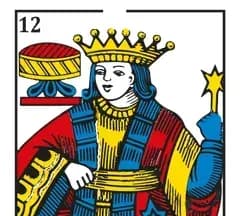 Rey of cups
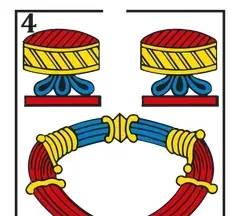 4 of cups
Situation 1: you must play higher, and the Rey is your only card above the Cabal, so you're forced to play it. If the 3 or Ace of copas follows, you lose your Rey. To avoid this, your partner needs to know you're weak in copas.
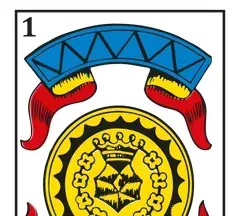 Ace of coins
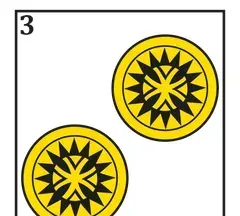 3 of coins
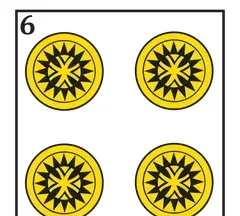 6 of coins
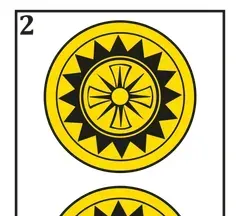 2 of coins
Situation 2: lead the Ace of oros, then the 3: the opponents must follow in trumps and play higher if they can. After two rounds they have few trumps left and your other suits are protected.
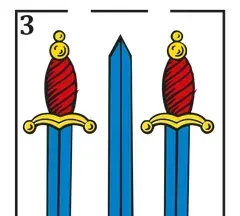 3 of swords
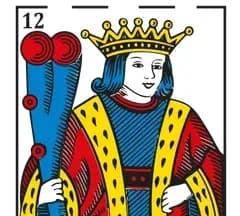 Rey of clubs
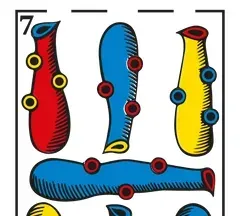 7 of clubs
Situation 3: the trick is already trumped by your partner, so you no longer have to play higher in bastos. If nobody after you can overtrump, play your Rey of bastos (4 points) rather than the 7.
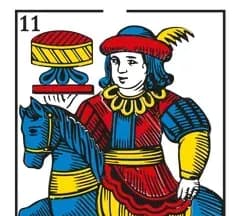 Cabal of cups
- Rey of cups
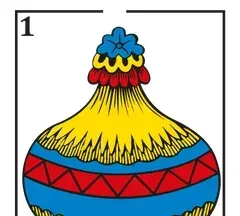 Ace of cups
Situation 4: your team hasn't won a trick yet, so your Ghna (+40) is waiting. Play the Ace of copas to win a trick as soon as possible, then declare the Ghna before the opponents force you to give up the Rey or the Cabal.
Practise in the app
The best training is playing. In the Atlas Carta app you can play Touti online, with friends or in tournaments. Keep the Touti glossary and the scoring guide handy.
Play Touti online
Frequently asked questions
What is the best strategy in Touti?
Bid well: count your sure points (Aces, guarded Threes), listen to your partner's signals and keep the Ghna caps in mind. Then draw trumps when you're the declarer and track the Aces and Threes.
Which suit should I choose as trumps?
Usually your longest (4 cards or more), especially if it holds the Ace or 3, or your Ghna (which is then worth 40 instead of 20).
Do you always have to play higher in the suit led?
Yes, if you have a card above the highest card of that suit already played. The exception: when the trick has already been trumped.
Do you have to trump your partner's trick?
If you can't follow suit and you have trumps, yes: trumping is compulsory even when your partner is winning the trick.
How do you stop the opponents' Ghna?
Lead the suit of the Ghna you suspect: the obligation to follow suit and play higher may force the declarer to give up the Rey or Cabal before declaring it.
Read also
Other games on Atlas
- RondaCapturing card game with a 40-card Spanish deck, for 2 players or 4 in teams of 2; the first side to 33 points wins.
- RummyRummy game with two 52-card decks and jokers: you lay down runs (Suivi, e.g. 7♥ 8♥ 9♥) and sets (Tria, e.g. 9♠ 9♥ 9♦). Simple, Rummy 51 and Rummy 71 modes, 1 vs 1 or 2 vs 2.
- BeloteTrick-taking game with trumps and declarations, for 4 players in 2 teams of 2. Moroccan variant with 32 Spanish cards to 1,000 points, or French variant with 32 French-suited cards to 1,000 points.
Play Touti online
On iOS and Android, play all four games online and invite your friends to a private table.