
Rummy rules: the complete guide
By The Atlas Carta teamUpdated on ✓ Rules checked in the app
Play Rummy online
Rummy rules in 30 seconds
- Equipment: two 52-card decks + 2 jokers (4 in Rummy 51).
- A turn: draw 1 card → lay down if you can → discard 1 card.
- Melds: the Suivi, a run (5♣ 6♣ 7♣) in one suit, and the Tria, a set (J♠ J♥ J♦) of one rank in different suits.
- Opening: in Simple you lay everything down at once at the end; in Rummy 51 your first lay-down is worth at least 51 points; in Rummy 71 at least 71 points without jokers, with a run (8♠ 9♠ 10♠) and a set (9♠ 9♥ 9♦).
- Winning: discard your last card. Opponents pay for their cards (a fixed 100 per loser in Simple); the side that reaches 600 points in Simple, 351 in Rummy 51 or 451 in Rummy 71 (300 points in Simple or 251 in Rummy 51 and 71 in 1 vs 1) loses.
Object of the game
The goal of each round is simple: be the first to get rid of all your cards, by forming them into melds and then discarding the very last one. When a player does it, the round stops and the opposing side takes penalty points: the value of the cards left in hand in Rummy 51 and 71, a fixed 100 points per loser in Simple. Rounds follow one another until one side reaches the limit (600 points in Simple, 351 in Rummy 51 or 451 in Rummy 71 in 2 vs 2, 300 points in Simple or 251 in Rummy 51 and 71 in 1 vs 1): that side has lost the game.
So in rummy you are not chasing points — you are trying to take as few as possible. Holding a hand full of face cards when an opponent goes out is expensive.
Equipment: two 52-card decks and jokers
Rummy is played with two standard 52-card decks (Ace, 2 to 10, Jack, Queen, King in the four suits ♠ ♥ ♦ ♣) shuffled together, plus jokers. Every card therefore exists twice: there are two 7♥ in the pack, and they are two separate cards.
| Variant | Standard cards | Jokers | Total |
|---|---|---|---|
| Simple | 2 × 52 | 2 | 106 cards |
| Rummy 51 | 2 × 52 | 4 | 108 cards |
| Rummy 71 | 2 × 52 | 2 | 106 cards |
The deal
The dealer starts with the player on their right and serves themselves last. The remaining cards form the face-down stock in the middle. The discard pile starts empty.
How many cards in rummy?
| Variant | Each player | Dealer | How they are dealt |
|---|---|---|---|
| Simple | 13 | 14 | 3 cards each, then 2 at a time; the dealer takes 3 in the last pass |
| Rummy 51 | 14 | 15 | 2 at a time; the dealer takes 3 in the last pass |
| Rummy 71 | 14 | 15 | 2 at a time; the dealer takes 3 in the last pass |
The dealer gets one extra card because they start without drawing: they play their first turn straight from their hand, then discard.
Who deals, and in which direction?
The first dealer is chosen at random. After that the deal passes to the right each round, and play goes counter-clockwise. In 2 vs 2, partners sit opposite each other, so the two teams take turns alternately.
Melds: the Suivi (run) and the Tria (set)
Every card you lay down must belong to a valid meld. There are only two kinds, and a meld always has at least three cards.
The Suivi (run)
A Suivi (5♥ 6♥ 7♥) is a run of at least three consecutive cards of the same suit, for example a Suivi (4♠ 5♠ 6♠ 7♠). Other rummy games call it a sequence. A Suivi (8♠ 9♠ 10♠) without a joker is a natural Suivi (3♣ 4♣ 5♣) (a “pure sequence”).
 4 of spades
 5 of spades
 6 of spades
 7 of spades
The Ace is either low (A-2-3) or high (Q-K-A), never both at once. A Suivi (K♥ A♥ 2♥) that goes “round the corner” is not allowed. A run (A♥ 2♥ 3♥ … K♥) can therefore span at most Ace to King or 2 to Ace: 13 cards.
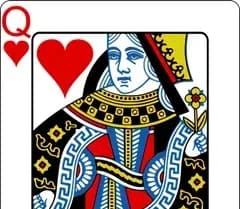 Queen of hearts
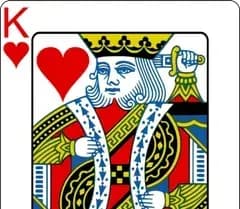 King of hearts
 Ace of hearts
- King of hearts
- Ace of hearts
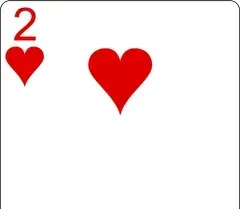 2 of hearts
The Tria (set)
A Tria (6♠ 6♥ 6♣) is three or four cards of the same rank, all in different suits: for example a Tria (9♠ 9♥ 9♦), or the same with the 9♣ to make four. Since the pack holds two copies of every card, watch out: two identical cards can never be in the same Tria: a Tria (9♠ 9♥ 9♥) is refused, because the two 9♥ share the same suit.
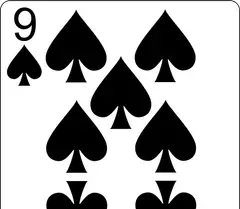 9 of spades
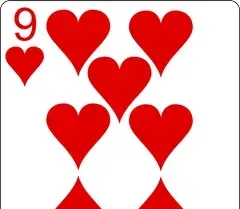 9 of hearts
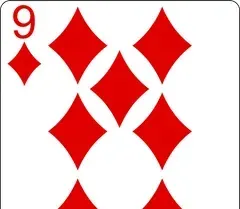 9 of diamonds
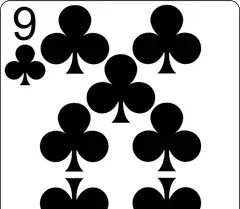 9 of clubs
- 9 of spades
- 9 of hearts
- 9 of hearts
The joker
The joker replaces any card in a Suivi (8♠ 9♠ 10♠) or a Tria (9♠ 9♥ 9♦). Three rules to remember:
- One joker per meld. A Suivi (6♦ joker 8♦) is fine; two jokers in the same meld are not.
- In a Suivi (6♦ 7♦ 8♦), the joker can fill a gap in the middle (6♦ joker 8♦) or extend the run at either end (6♦ 7♦ joker).
- A joker thrown on the discard pile can never be picked up again. Throwing it away gives it to nobody.
- A joker is never the tournante: discarded first by the dealer, it goes straight onto the discard pile.
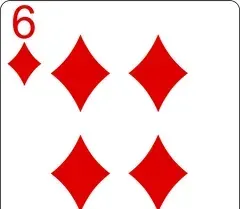 6 of diamonds
- JOKERJoker
 8 of diamonds
The joker counts differently by variant: in Rummy 51 it is worth the card it replaces; in Rummy 71 it does not count toward the 71 points; in Simple it is allowed everywhere. Details below, under opening by variant.
How a turn works: draw, meld, discard
- Draw exactly one card: the top of the stock, or the face-up card of the discard pile (under the conditions below).
- Lay down, if you can and want to: open, lay new melds, add to melds on the table (Rummy 51 and 71), or lay out your whole hand to go out (Simple).
- Discard one card onto the discard pile. Your turn is over; play passes on.
Draw from the stock or take the discard?
- In Simple, you may freely take the face-up discard.
- In Rummy 51 and 71, you only take it to lay it down in the same turn (in your opening, a new meld or an add-on). If you change your mind, you give it back and draw from the stock.
- In Rummy 71, to open with the card taken from the discard pile, you need a run (3♠ 4♠ 5♠) made without it: with the 8♥ taken, run (6♥ 7♥ 8♥) + set (9♠ 9♥ 9♦) is not enough. The tournante is not affected.
- In every variant, a card taken from the discard pile cannot be discarded again in the same turn.
- With only one card in hand, you can no longer take the discard, nor the tournante: you draw from the stock.
- A joker on the discard pile is never taken back.
When the stock runs out, the discard pile except its top card is gathered, shuffled and becomes the new stock. Play carries on as normal.
The first round of turns and the “tournante”
During the very first round of turns, until play comes back to the dealer, nobody lays anything down: no opening, no meld, no going out. Everyone draws and discards while sorting their hand.
All three variants (Simple, Rummy 51 and Rummy 71) add the tournante: the dealer’s first discard is set aside. During that first round, each player in turn can take it as their draw (with no obligation to lay it down), or look at it, hand it back and draw from the stock. If nobody keeps it, it slides under the discard pile at the end of the first round. A joker is never the tournante: if discarded first, it goes straight onto the discard pile, and there is no tournante that round. A player holding a single card cannot take it.
Always keep one card to go out
You can never lay down all your cards: every lay-down must leave you at least one card in hand. That is your closing card: discarding it ends the round and wins it for you. You choose freely which one to keep.
Opening: the rules by variant
The opening is your first lay-down of the round. This is where the three variants really differ.
| Simple | Rummy 51 | Rummy 71 | |
|---|---|---|---|
| When to lay down | All at once, to go out | As soon as the opening is ready | As soon as the opening is ready |
| Minimum points | None | 51 | 71 (no jokers) |
| Required melds | A run (5♥ 6♥ 7♥) and a set (9♠ 9♥ 9♦) | None | A run (8♠ 9♠ 10♠) and a set (6♠ 6♥ 6♣), no jokers |
| Card taken from the discard pile | Free to take | Laid down the same turn | Laid down the same turn; to open, a run (3♠ 4♠ 5♠) made without it |
| Joker | Allowed everywhere | Worth the card it replaces | Laid on top, not counted in the 71 |
| After opening | — (round over) | Free melds and add-ons | Free melds and add-ons |
Each variant has its own page: Simple rummy, Rummy 51 and Rummy 71.
Card values for the opening
| Card | Value |
|---|---|
| 2 to 10 | Face value (2 to 10 points) |
| Jack, Queen, King | 10 points |
| Ace low in a run (A-2-3) | 1 point |
| Ace high in a run (Q♦ K♦ A♦) or in a set (A♠ A♥ A♣) | 10 points |
| Joker (Rummy 51) | The value of the card it replaces |
Example: a Suivi (10♥ J♥ Q♥ K♥) is worth 40 points, a Tria (5♠ 5♥ 5♦) is worth 15. Together: 55 points, a valid opening in Rummy 51. Check your own hands with the opening calculator.
 10 of hearts
 Jack of hearts
- Queen of hearts
- King of hearts
- 5 of spades
 5 of hearts
 5 of diamonds
The rising threshold
In Rummy 51 and 71 the threshold is not fixed. Once one side has opened, the other side must open with at least that first opening’s total + 1. If your opponent opens with 63, you need 64.
In 2 vs 2, the partner of a player who has already opened has no threshold: in Rummy 51 they lay down freely; in Rummy 71 they only need a Suivi (5♥ 6♥ 7♥) without a joker (the app’s current rule). It is all explained in partners rummy.
Adding cards and swapping the joker
In Rummy 51 and 71, once you have opened you can, on each of your turns, lay new melds and add cards to any meld on the table — yours, your partner’s, and your opponents’ too. A 10♠ extends a Suivi (7♠ 8♠ 9♠); the K♣ completes a Tria (K♠ K♥ K♦).
Swapping the joker: a player who has already opened can take back a joker on the table by replacing it with exactly the card it represents. In a Suivi (6♦ joker 8♦), the 7♦ frees the joker. In a Tria (4♠ 4♥ 4♦), the joker can only be swapped if it is the fourth card: with (6♠ 6♥ 6♦ joker), the 6♣ frees it; with (6♠ joker 6♦), a 6 is simply added and the joker stays. The freed joker goes into your hand to be played whenever you like.
Winning the round
You win the round by discarding your last card. There are three ways to get there:
- Going out after opening (Rummy 51 and 71): you have laid down bit by bit, one card is left, you discard it.
- Laying everything down to go out (Rummy 51 and 71): if you can lay down all your cards but one, you may do so even below the threshold, then discard the last one. The variant’s requirements still apply: in Rummy 71 you still need a run (3♣ 4♣ 5♣) and a set (6♠ 6♥ 6♣) without jokers, and if you took the discard this turn, a run (7♦ 8♦ 9♦) built without it. If you had not laid anything down before, that is going rummy (“rami sec”): it is allowed and does not double the penalties.
- Going out in Simple: you lay down everything but one card at once, with at least one run (5♥ 6♥ 7♥) and one set (4♠ 4♥ 4♦), then discard the last one.
Very rare case: if the stock is empty and there is nothing left to reshuffle, the round ends with no winner and nobody pays.
Scoring and end of the game
At the end of the round, only the winner’s opponents pay. In 2 vs 2, the winner’s partner pays nothing, and the two opponents add their penalties together. The scale depends on the variant.
| Card in hand | Penalty |
|---|---|
| 2 to 10 | Face value |
| Jack, Queen, King | 10 |
| Ace | 11 |
| Joker | 20 |
| Player who laid nothing down (Rummy 51 and 71) | Flat 100 (200 if both players of a team) |
In Simple the scoring is fixed: cards are not counted, each loser takes 100 points, whatever their hand. In 1 vs 1 the loser takes 100; in 2 vs 2 the losing team takes 200 (100 per player), and both the winner and their partner stay at 0.
Penalties add up from round to round. In 2 vs 2, the team that reaches 600 points in Simple, 351 in Rummy 51 or 451 in Rummy 71 loses; in 1 vs 1, the player who reaches 300 points in Simple or 251 in Rummy 51 and 71 loses. Since only one side pays each round, there is never a tie. All the tables and worked examples are on the rummy scoring page.
Playing as a team: your partner’s role
In 2 vs 2, partners share one score. Once one of them has opened, the other can lay down without a threshold (in Rummy 71, with a Suivi (5♥ 6♥ 7♥) without a joker), and both can add to melds on the table. Going out fast often means winning together: → partners rummy, rules and tactics.
How this differs from “classic” Rummy 51
Rummy comes with countless house rules. If you learned Rummy 51 at home or on another site, here are the most common differences with the Atlas Carta app version:
| Rule | Often elsewhere | In the Atlas Carta app |
|---|---|---|
| Cards in hand | 13 (14 for the first player) | 14 (15 for the dealer) in Rummy 51 and 71; 13/14 in Simple |
| To open with 51 | A pure run (no joker) is often required | No meld required |
| Joker in the opening | Depends on the house: counted or not | Worth the card it replaces |
| Opponent’s threshold | Always 51 | Rises: first opening + 1 |
| Format | Every player for themselves | 1 vs 1 or 2 vs 2 |
| End of game | Varies | Lost at 600 points in Simple, 351 in Rummy 51 or 451 in Rummy 71 (2 vs 2) or 300 points in Simple or 251 in Rummy 51 and 71 (1 vs 1) |
To explore the other members of the rummy family (Gin Rummy, Rummikub, Kalooki, 13-card rummy…), read our page on rummy variations.
Going further
- 15 rummy strategy tips to take fewer points.
- The rummy glossary: Suivi (3♣ 4♣ 5♣), Tria (6♠ 6♥ 6♣), tournante, going rummy… with their French, Spanish and Arabic equivalents.
Play Rummy online
Frequently asked questions
How many cards in rummy?
In the Atlas Carta app: 13 cards each in Simple (14 for the dealer) and 14 cards in Rummy 51 and Rummy 71 (15 for the dealer). The pack has 106 cards (2 jokers), or 108 in Rummy 51 (4 jokers).
Is the ace high or low in rummy?
Either, but not both in the same run: (A♥ 2♥ 3♥) or (Q♦ K♦ A♦). For the opening, the Ace is worth 1 when low in a Suivi (A♥ 2♥ 3♥) and 10 when high in a Suivi (Q♦ K♦ A♦) or in a Tria (A♠ A♥ A♣). Left in hand at the end of a round, it costs 11 points (Rummy 51 and 71).
Can you go round the corner (K-A-2) in rummy?
No. The Ace is either low or high, never both: a run (K♥ A♥ 2♥) is refused.
Can you add to other players’ melds?
Yes, in Rummy 51 and 71: once you have opened, you can add cards to every meld on the table, including your opponents’.
What is the joker worth in rummy?
In a Rummy 51 opening, the card it replaces (6, joker, 8 = 21 points). In Rummy 71 it does not count toward the 71 points. Left in hand at the end of a round, it costs 20 penalty points (Rummy 51 and 71).
What happens when the stock runs out?
The discard pile, except its top card, is shuffled and becomes the new stock, and play continues.
Can you pick up from the discard pile?
Yes. Freely in Simple; in Rummy 51 and 71 only to lay that card down in the same turn. You can never discard the card you just picked up, and a discarded joker is never taken back.
Is there a tournante in Simple rummy?
Yes. The tournante exists in all three variants: the dealer’s first discard can be taken instead of drawing during the first round of turns. A joker is never the tournante.
How do you win rummy?
By taking as few points as possible: every round, the winner’s opponents pay (their cards in Rummy 51 and 71, a fixed 100 per loser in Simple). The team that reaches 600 points in Simple, 351 in Rummy 51 or 451 in Rummy 71 loses (300 points in Simple or 251 in Rummy 51 and 71 in 1 vs 1).
Read also
Other games on Atlas
- ToutiTrick-taking and bidding card game (bids from 70 to 230) for 4 players in 2 teams, played with a 40-card Spanish deck; the first team to 600 points wins.
- RondaCapturing card game with a 40-card Spanish deck, for 2 players or 4 in teams of 2; the first side to 33 points wins.
- BeloteTrick-taking game with trumps and declarations, for 4 players in 2 teams of 2. Moroccan variant with 32 Spanish cards to 1,000 points, or French variant with 32 French-suited cards to 1,000 points.
Play Rummy online
On iOS and Android, play all four games online and invite your friends to a private table.