History of Touti: what we know, and what we don’t
By The Atlas Carta teamUpdated on
Play Touti online
A game passed on from player to player
People usually learn Touti by watching others play, then sitting down at the table, with family or friends. The rules are handed down from one generation to the next, with no single reference text. That is what makes the game rich, and also why two tables don't always play in exactly the same way: target score, minimum bid, Ghna caps… Our page on variants presents several of them, compared with the app's rules.
This oral transmission has a consequence for anyone looking into its history: there are few old written traces of the game under this name. Any precise claim about a date or place of birth for Touti would, as things stand, be impossible to check.
The name "Touti" and its spellings
The name is spelled in several ways: Touti, Tutti, Toutti, Tuti, Toti, or توتي in Arabic. These spellings mostly reflect how the word is pronounced, written down in different alphabets and languages.
The word looks like the Italian *tutti*, "all". The connection is tempting, but no reliable source allows us to say the name of the game comes from it. We prefer to present it as a mere resemblance.
The 40-card Spanish deck
While the origin of Touti is hazy, its equipment is better known. Touti is played with the Spanish deck, whose four suits (oros, copas, espadas and bastos: coins, cups, swords and clubs) belong to the family of so-called "Latin" suits. Cards of this type are recorded in Europe from the late Middle Ages, and they are still widespread today.
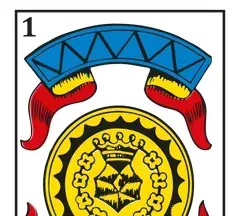 Ace of coins
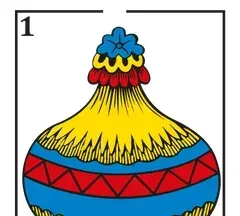 Ace of cups
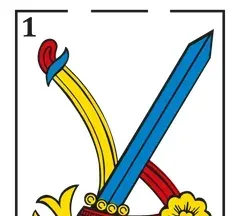 Ace of swords
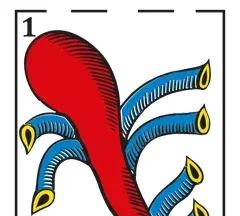 Ace of clubs
The 40-card deck has no 8s or 9s: each suit runs from Ace to 7, then moves on to the three court cards, the Sota (10), the Cabal (11) and the Rey (12). To learn all about this deck, see Spanish playing cards and the Touti cards.
Words that tell the story of the game
Touti's vocabulary mixes several languages, and it may be the best historical witness we have:
- The names of the court cards, Sota, Cabal and Rey, come straight from the Spanish deck.
- The Ghna, the Rey and Cabal of the same suit together, has a name of its own in Touti. It is also called "compte".
- The bidding signals, AS, COMPTE, +10 and PASS (PASSE), are borrowed from French.
This mix shows a living game, one that has travelled between players speaking different languages. The Touti glossary gathers all these words, with their French, Spanish and Arabic equivalents.
What gives Touti its identity
Whatever its history, Touti can be recognised by a few strong features, all found in the rules applied by the app:
- a bid from 70 to 230, in which the team commits to a number of points;
- a coded dialogue between partners during the auction (AS, COMPTE, +10, PASS);
- the Ghna, capped by the size of the bid;
- the obligation to play higher and to trump, which makes every trick tense;
- a scoring system in which only the team that wins the hand scores the bid amount, up to 600.
From the table to online play
For a long time, you needed four players in the same place for a game. Online play changed that: today you can meet your usual partners at a distance, or take on players from all over the world. In the Atlas Carta app, Touti is played with fixed rules, the same for everyone, which gives the game a common rulebook without erasing the traditions of family tables.
Play Touti online
What we still don’t know
- When and where Touti took its current form.
- The certain origin of its name and of the word Ghna.
- The precise history of the Ghna caps and the bidding signals.
Frequently asked questions
Where does Touti come from?
Its exact origin is not documented: the game has mostly been passed on from player to player, with no old reference text. What is certain is that it is played with the 40-card Spanish deck.
What does "Touti" mean?
The word looks like the Italian tutti ("all"), but no reliable source allows us to say the name of the game comes from it.
Should it be spelled Touti or Tutti?
Both spellings exist, as do Toutti, Tuti, Toti and توتي. On this site, we write Touti.
Why do Touti rules vary?
Because they are mostly passed on by word of mouth: every table ends up with its own habits. The app, for its part, applies one single set of rules to every game.
Read also
Other games on Atlas
- RondaCapturing card game with a 40-card Spanish deck, for 2 players or 4 in teams of 2; the first side to 33 points wins.
- RummyRummy game with two 52-card decks and jokers: you lay down runs (Suivi, e.g. 7♥ 8♥ 9♥) and sets (Tria, e.g. 9♠ 9♥ 9♦). Simple, Rummy 51 and Rummy 71 modes, 1 vs 1 or 2 vs 2.
- BeloteTrick-taking game with trumps and declarations, for 4 players in 2 teams of 2. Moroccan variant with 32 Spanish cards to 1,000 points, or French variant with 32 French-suited cards to 1,000 points.
Play Touti online
On iOS and Android, play all four games online and invite your friends to a private table.