Belote rules: how to play, step by step
By The Atlas Carta teamUpdated on ✓ Rules checked in the app
Play Belote online
Belote in 2 minutes
- 4 players, 2 teams: partners sit opposite each other.
- 32 cards: a Spanish deck in Moroccan Belote or a French-suited deck in French Belote.
- Everyone gets 5 cards, then one card is turned face up in the middle.
- Each player says “Take” or “Pass”; in the second round you may take by naming another suit.
- The taker gets the face-up card + 2 cards, the others 3 cards: everyone holds 8.
- Play 8 tricks: follow suit, otherwise trump, and always go higher in trumps when you can.
- During trick 1, declare your sequences (Suivis) and fours (Carrés); the 11 and 12 of trumps make Belote-Rebelote (20 points).
- A hand is worth 162 trick points; the taking team must score more than the other. Play to 1,000 points in either variant.
Cards and players
Belote is played by four people in two teams of two. Your partner sits opposite you, so turns alternate between your team and your opponents. The app offers only this format (no 2- or 3-player Belote).
Moroccan Belote uses 32 Spanish cards: the 1 (Ace), 4, 5, 6, 7, 10 (Sota), 11 (Caballo) and 12 (Rey) of each suit. French Belote uses 32 French-suited cards: 7, 8, 9, 10, Jack, Queen, King and Ace in each suit. Card strength and points correspond: the Spanish 10 plays the role of the Jack, the 6 of the 9, the 11 of the Queen and the 12 of the King. See our Belote cards page.
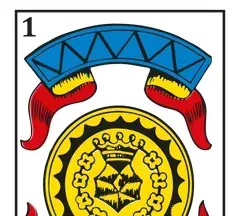 Ace of coins
 4 of coins
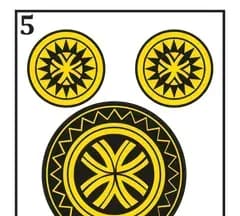 5 of coins
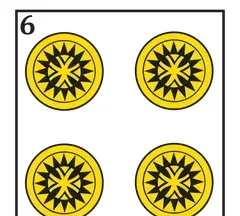 6 of coins
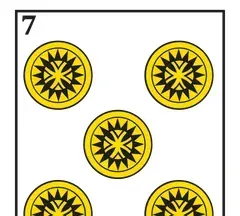 7 of coins
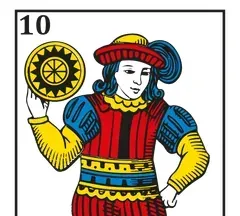 Sota of coins
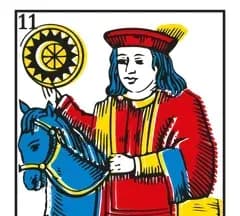 Cabal of coins
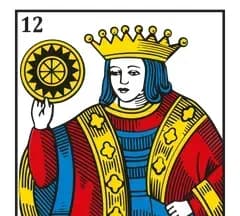 Rey of coins
Card ranking and values
This is the first rule to learn: cards rank differently in trumps and in the other suits. Two cards completely change role when their suit becomes trumps: the 10 and the 6.
| Spanish card | French-suited equivalent | Trump points | Non-trump points |
|---|---|---|---|
| 10 (Sota) | Jack | 20 | 2 |
| 6 | 9 | 14 | 0 |
| 1 (Ace) | Ace | 11 | 11 |
| 7 | 10 | 10 | 10 |
| 12 (Rey) | King | 4 | 4 |
| 11 (Caballo) | Queen | 3 | 3 |
| 5 | 8 | 0 | 0 |
| 4 | 7 | 0 | 0 |
| Total for one suit | — | 62 | 30 |
In trumps
Ranking: 10 > 6 > 1 > 7 > 12 > 11 > 5 > 4. The 10 of trumps (20 points) is the strongest card in the game, followed by the 6 of trumps (14 points). The eight trumps are worth 62 points in total.
In plain suits
Ranking: 1 > 7 > 12 > 11 > 10 > 6 > 5 > 4. The Ace is highest, then the 7. Each plain suit is worth 30 points, 90 for the three. Add the 62 of trumps and the deck is worth 152 points.
How to remember it
The deal
The first dealer is chosen at random; after that, the deal passes to the right each hand. Play goes counter-clockwise.
Each player receives 5 cards (a packet of 3, then a packet of 2). One card is then turned face up in the middle: the “turn-up”. The remaining cards are used to complete the hands once the trump suit is chosen.
Choosing trumps (taking)
Bidding starts with the player to the dealer’s right and goes around the table.
First round: take or pass
In turn, each player says “Take” or “Pass”. Taking in the first round means accepting the suit of the turn-up as trumps. As soon as someone takes, bidding ends: that player is the taker, and their team must make the contract.
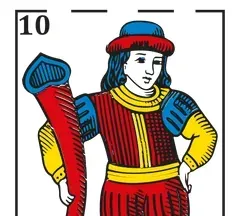 Sota of clubs
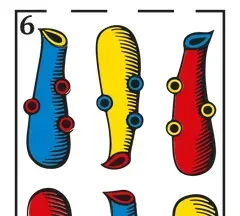 6 of clubs
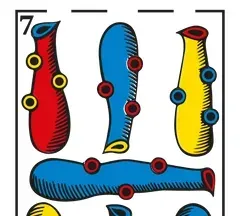 7 of clubs
- Ace of coins
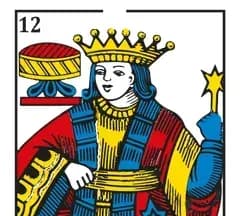 Rey of cups
Second round: name another suit
If all four players pass, a second round starts, again with the player to the dealer’s right. Now you may take by naming one of the three other suits as trumps (not the turn-up’s suit).
If everyone passes twice
The hand is cancelled: nobody scores, the cards are shuffled and the next dealer (to the right) deals again.
Completing the deal
The taker picks up the turn-up and 2 cards; each of the other three players receives 3 cards. Everyone now holds 8 cards and play begins.

Playing the tricks
There are 8 tricks of 4 cards. The player to the dealer’s right leads the first trick; after that, whoever wins a trick leads the next.
Follow suit
The first card of the trick sets the suit led. If you have that suit, you must play one — any of them when it isn’t trumps.
This obligation comes before all the others: you must follow suit even if an opponent has already trumped (your card can no longer win) and even if your partner has trumped. You only trump when you have no card at all of the suit led.
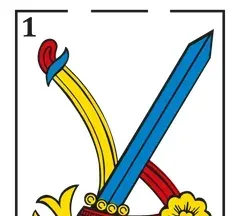 Ace of swords
- Sota of clubs
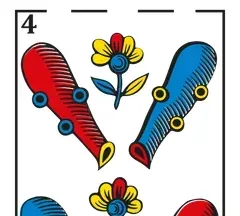 4 of clubs
- 7 of coins
Trump when you can’t follow
If you have no card of the suit led and an opponent is winning the trick, you must trump, i.e. play a trump. Exception: if your partner is master of the trick (their card is currently the highest), you are free: discard another suit or trump with any trump you like.
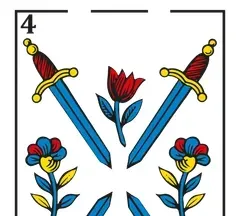 4 of swords
- 5 of coins
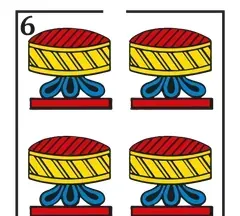 6 of cups
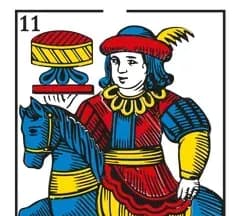 Cabal of cups
Overtrump, otherwise undertrump
If an opponent has already trumped, you must overtrump: play a higher trump. If you don’t have a higher one, you must still play a lower trump: undertrumping is compulsory. You may only discard when you have no trumps at all.
- 6 of coins
- Rey of coins
- 7 of clubs
When trumps are led: go higher
If a trump is led, you must follow with a trump going higher: play a trump above the highest one already played if you have one; otherwise a lower trump. Here the “partner is master” exception does not apply: even if your partner is winning, you must go higher when trumps are led.
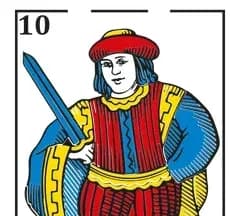 Sota of swords
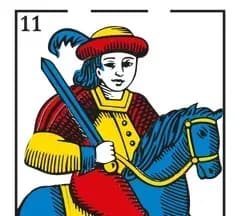 Cabal of swords
- Ace of coins
Neither the suit nor trumps: any card
If you have neither the suit led nor a trump, play any card: it is a discard and cannot win the trick.
Who wins the trick
The trick goes to the highest trump played; if there is none, to the highest card of the suit led (plain-suit ranking). A card of another plain suit never wins.
Declarations (Suivis and Carrés)
During the first trick, as you play your first card, you can declare combinations from your hand. A forgotten declaration is lost.
| Declaration | Example | Points |
|---|---|---|
| Suivi (sequence) of 3 cards | 5-6-7 of cups | 20 |
| Suivi of 4 cards | 7-10-11-12 of coins | 50 |
| Suivi of 5 cards or more | 4-5-6-7-10 of clubs | 100 |
| Carré (four) of 10s | the four 10s (Sota) | 200 |
| Carré of 6s | the four 6s | 150 |
| Carré of 1s, 7s, 11s or 12s | the four 12s (Rey) | 100 |
| Carré of 4s or 5s | the four 5s | 0 (does not count) |
A Suivi is at least 3 consecutive cards of the same suit, in the order 4, 5, 6, 7, 10, 11, 12, 1 (7 and 10 are consecutive: there are no 8s or 9s). A card can only be used in one declaration. At the start of the second trick, each team’s best declaration is compared: the winning team shows and scores all its declarations; the other team’s stay hidden and score nothing. Ties and revealed cards are explained in our declarations guide.
Belote and Rebelote
If you hold the 11 and 12 of trumps, say “Belote” when you play the first of them and “Rebelote” when you play the second, in either order. Your team scores 20 points, always kept, even if the contract fails. They are not part of the declaration comparison.
- Cabal of cups
- Rey of cups
Scoring a hand
- Tricks: 152 card points + 10 for the last trick = 162.
- Capot: the team that wins all 8 tricks counts 252 (the other 0).
- Contract made: the taking team’s total (tricks + declarations + Belote) is strictly higher than the defenders’. Each team then scores its own total.
- Contract failed (“inside”): the defenders score 162 (252 if they made capot) + all validated declarations + their Belote; the taking team keeps only its Belote.
- Tie (exactly equal): the defenders score their points at once; the taking team’s points (except Belote) go into reserve and will go to the team that wins the next hand that is not a tie.
Without declarations, the taking team therefore needs at least 82 of the 162 points (81-81 is a tie). Worked examples and a calculator: how to count points in Belote.
End of the game
A game is played to 1,000 points in Moroccan Belote or 1,000 points in French Belote. The current hand is always finished before looking at the scores. If only one team has reached its variant’s target, it wins. If both pass the target on the same hand, the higher total wins; if they are exactly equal, a deciding hand is played.
Common beginner mistakes
- Forgetting to declare during the first trick: the declaration is lost, even four 10s.
- Always trumping when your partner is already winning: it isn’t compulsory and often wastes a trump.
- Forgetting to go higher when trumps are led — the app won’t let you, but at a real table it is a fault.
- Saying “Rebelote” without “Belote”: 0 points.
- Underestimating the last trick: 10 points, often the gap between a made contract and a tie.
- Taking with a single big trump: without the 10 or 6 well supported, failing costs your team 162 points.
Play Belote online
Frequently asked questions
Do you have to trump in Belote?
Yes: if you can’t follow suit and an opponent is winning the trick, you must play a trump (and overtrump if you can). You don’t have to trump when your partner is winning the trick, or when you have no trumps left.
Do you have to go higher in trumps?
Yes. When trumps are led, you must play a trump higher than the highest one already played if you have one, even if your partner is winning. If you don’t have a higher one, you play a lower trump.
What if my partner is winning the trick?
If the suit led is not trumps and you can’t follow, you are free: discard a small card or trump with any trump, even one lower than your partner’s. If you have the suit led, you must still follow.
What is the highest card in Belote?
The 10 of trumps (the Sota, equivalent to the Jack), worth 20 points. Next come the 6 of trumps (14 points) and the Ace of trumps (11 points).
How many cards does each player get?
Five at first, then eight after the deal is completed: the taker receives the turn-up and 2 cards, the others 3 cards.
Who plays first in Belote?
The player to the dealer’s right speaks first when choosing trumps and leads the first trick. After that, the winner of each trick leads the next one.
What happens if everyone passes?
If nobody takes after two rounds, the hand is cancelled and the next dealer deals again. Nobody scores.
Can you play Belote with 2 or 3 players?
Two- and three-player variants exist, but they change the game a lot. In the Atlas Carta app, Belote is played only by 4, in 2 vs 2.
Read also
Other games on Atlas
- ToutiTrick-taking and bidding card game (bids from 70 to 230) for 4 players in 2 teams, played with a 40-card Spanish deck; the first team to 600 points wins.
- RondaCapturing card game with a 40-card Spanish deck, for 2 players or 4 in teams of 2; the first side to 33 points wins.
- RummyRummy game with two 52-card decks and jokers: you lay down runs (Suivi, e.g. 7♥ 8♥ 9♥) and sets (Tria, e.g. 9♠ 9♥ 9♦). Simple, Rummy 51 and Rummy 71 modes, 1 vs 1 or 2 vs 2.
Play Belote online
On iOS and Android, play all four games online and invite your friends to a private table.